Finally, somewhere to put your drink at the TV tray.
122 reviews · 4.9 average · 98 verified purchases
Steadi Labs LLC — Scott Rodriguez, founder. Veteran founded.
3419 E Chapman Ave #411, Orange, California · hello@steadilabs.com
“First time I have ever ordered from Facebook feed. Very easy. Happy with product.”Steve Butler · 8 August 2026
A flexible-finned base holds your glass steady right on the tray — through the fork cuts, the elbow bumps, and the carpet wobble already working against it before the plate even lands.
Fix tray night for $14.95Free shipping, 90 days to send it back, no questions — from a small maker in Orange, California, not an overseas gadget shop.
The problem, named
The tray solved the plate. Never the glass.
TV trays have been carrying dinner to the couch since before the TV dinner itself — the folding top was advertised nationally a full year before Swanson's compartment tray gave it something to hold. Seventy-some years later, the plate still has a plan. The drink is still improvising.
A dinner plate claims most of the 14-by-19-inch surface, so the glass lands inches from the edge — and on a top this light, every downward fork cut and every elbow bump travels straight through the frame to whatever's standing on it. Owners also learn the hard way that a sweating glass set straight on the wood or laminate can leave the finish blistered underneath it.
Four skinny leg tips sink into carpet pile at different depths, so the tray settles out of level before dinner even starts and stays springy underfoot the whole meal. There's an entire genre of how-to guides on shimming a wobbly folding table on carpet — which is its own proof the wobble is real.
Once the plate fills the tray, the arm becomes the overflow shelf — except it's crowned, upholstered foam with no flat spot on it. It dips the moment a forearm lands or a shoulder shifts, and the glass slides toward the cushion or the carpet.
The other overflow spot, and no steadier: soft foam and loose fabric that tilt under any concentrated weight and re-shape themselves each time anyone on the couch moves, stands, or flops back down.
Hard and flat, which sounds promising — except it sits low, past the loaded tray, and is usually covered in remotes and controllers already. Getting the drink there means leaning over your own plate, so most people just leave it out of reach until the meal's over.
None of it ruins dinner. Every surface just does exactly what a TV tray was built to do to a drink — and the trays go back on the rack with nobody having stopped to notice it happened again tonight.
The moments
A TV-tray dinner, blow by blow.
Every downward cut travels through the thin folding frame — one reviewer put it plainly, that a tray trembling with every forkful can ruin the evening — and the glass parked at the back corner rings and creeps toward the edge.
Getting off a low couch means pushing past the tray you just sat behind. A thigh catches the top, a foot clips a leg, and the whole surface lurches with the drink still riding it.
Four trays come off the storage rack and onto the carpet, and the legs sink to four different depths before anything's even on top — the shaky-on-carpet complaint, arriving before dinner does.
A full dinner plate takes most of a 14-by-19-inch top, so the glass gets exiled — half off the back corner, or abandoned on the couch arm instead of the tray at all.
Lifting the tray at the end of the night reveals the ring underneath: condensation from the cold glass soaked in all evening, right where the finish is known to blister.
The fit question
The bottom inch decides what rides the tray.
One line decides every verdict: a container base 2 to 3 inches across settles in. Here's how the usual TV-dinner lineup shakes out.
- Stemmed wine glass fits
- Stemless wine glass fits
- 12 oz can fits
- Slim seltzer can fits
- Pint glass or water tumbler fits
- 40 oz Stanley-style tumbler fits
- Longneck beer bottle fits
- Handled coffee mug handle in the way
There's a floor as well as a ceiling — under 2 inches, the base sits too loose in the fins. And the handled mug is the honest exception on any tray: the base fits, but the handle lands right where a fin needs to grip.
The full fit database — Stanley, Red Bull, Yeti, and 30 more, with sourced base measurements →
The 10-second check
The fit test takes less time than unfolding the tray.
lands in here
A square sticky note: exactly 3 inches — the ceiling of what fits, checked before the plate even lands.
The classic square is exactly 3 inches on a side. That's a fact about sticky notes — and it happens to be the exact ceiling of what fits.
Right there on the tray, before the plate goes down. Judge the bottom, not the rim — a stemmed wine glass flares at the top and tapers underneath, and the base is the only part that ever gets held.
Base lands inside the square? It fits. Hangs over the edges? Too wide. A little puck lost in the middle — under 2 inches? Too narrow.
No ruler, no tape measure hunting through the junk drawer — one sticky note, one glance, before the wine glass goes anywhere near a folding leg.
Versus what you do now
A better tray was never the fix.
| A sturdier wooden tray set | The TV Tray Cup Holder | |
|---|---|---|
| The fork cut, mid-bite | Sturdier legs — the shake still reaches the top | Grips the glass, holds steady through it |
| Legs settling into carpet | Better hinges, same shaky-on-carpet complaint | Doesn't need the tray level to hold on |
| The ring under a sweating glass | Nicer finish, same blistering risk | Sweat lands in the base, not the wood |
| Standing up for a refill | A bumped leg still lurches the whole top | Fins hold on — the glass resists tipping |
| Once the plate lands | Still no spot built in for the glass | Settles into whatever room's left |
| Overall build and finish | Genuinely nicer wood, sturdier legs — a real upgrade | Doesn't touch the tray, only the glass on it |
| Cost | A whole new tray set to justify | One small piece for the tray you already own |
The complaints follow the category up the price ladder: still shaky on carpet, tops that arrive warped, hinge holes misaligned from the factory, hinges that loosen after months of nightly folding, and finishes that blister under a sweating glass. A better tray reduces the wobble. Nothing about it holds the drink.
Reviewers call the plastic flimsy and describe the top sagging under any real weight — it won't even stand upright when folded. A cantilevered, sagging surface is close to the worst possible place to park a full glass.
Fit is the catch: guides warn you to measure the arm first, the clips max out around 9 inches wide, and several models simply don't fit a rounded or overstuffed arm. The bamboo versions also need care around moisture — an odd ask for something meant to hold a wet glass.
Almost none of the household sets in the buying guides have one — the closest most offer is a raised tray lip. Built-in holders mostly show up on lightweight camping tables, and a fixed-size cutout only fits the one cup it happens to fit.
Folded cardboard, foam wedges, whatever's on hand — there's a whole genre of how-to content on stabilizing a wobbly folding table, which is itself evidence the problem is real. Shims are fiddly, they fall out, and they have to go back in each time the tray folds up and sets up again, which with TV trays means nightly.
What's in it
Three reasons it beats the wobble.
Steady on a tray that isn't
The wide, low base and the fin grip do the same job on a hard, flat tray top that they do everywhere else — this isn't a soft-surface trick. A fork cut or an elbow bump doesn't get a free runway across the laminate: the base holds its footprint and the drink resists tipping instead of creeping toward the edge.
Holds the whole TV-dinner lineup
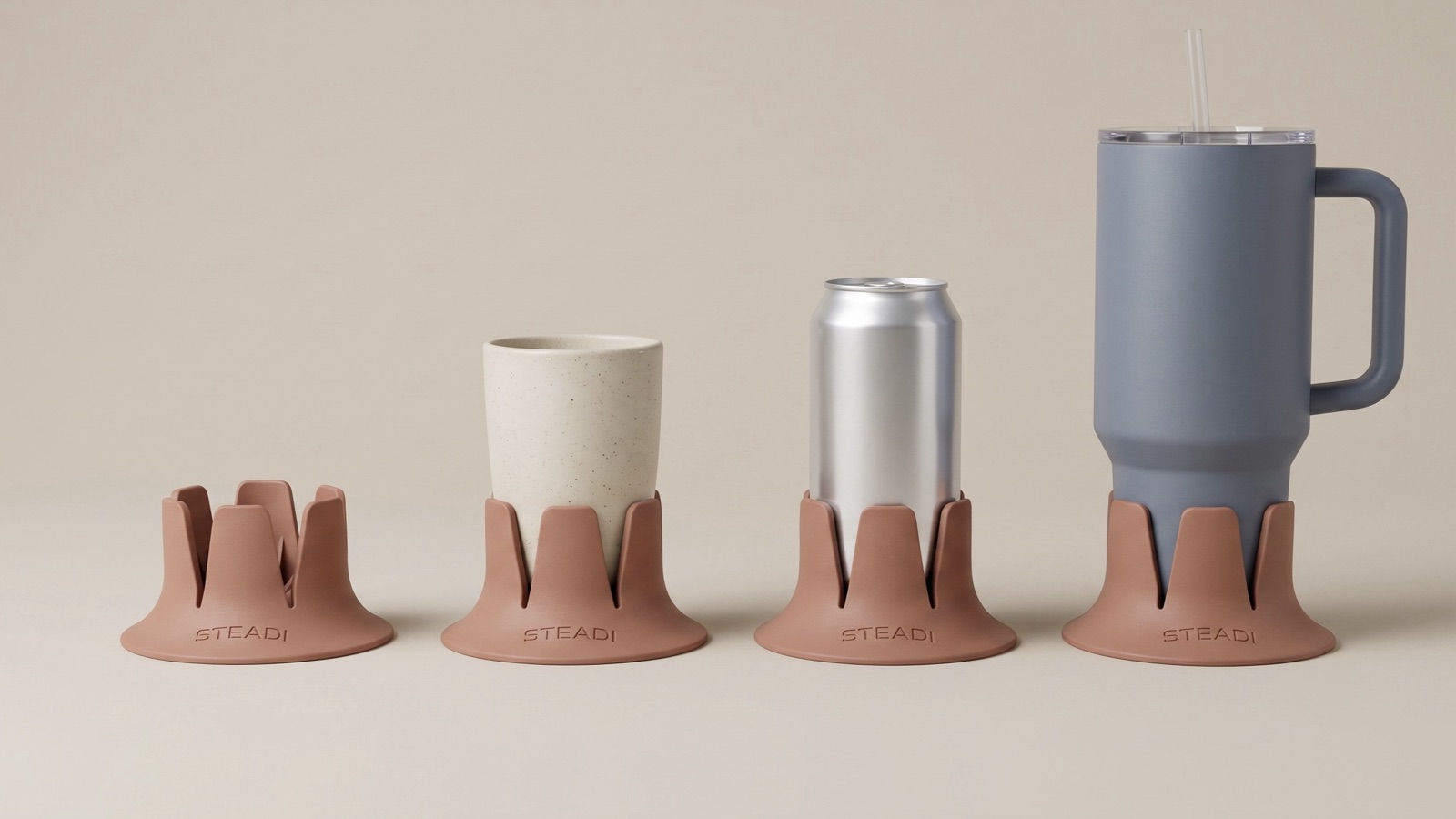
The tall stemmed wine glass, the can, the slim seltzer, the 40 oz tumbler — the base doesn't play favorites among what actually shows up at a couch dinner. Cans and bottles slide on; the wine glass and the tumbler drop in through the fins and get held by the bottom inch.
No clamp, no ring, no damage
One piece of matte flexible material — no clip hunting for the arm's width, no cutout sized for one cup, no hardware to lose. The sweat off a cold glass lands in the base instead of soaking into the wood, so the tray comes off the rack the next night the same as it went on.
Plain mechanics
Built for a top that shakes with every cut.
A glass standing alone balances everything on its own small footprint, so a bumped tray gets full leverage on it. The wide, low base spreads that contact across the tray top instead of letting a narrow base ride the tremor by itself.
Flexible fins hold the glass or can from the sides, by the bottom inch — grip, not suction, so there's nothing to peel loose when the tray gets folded down and unfolded again tomorrow night.
A fork cuts, an elbow lands, someone brushes past on the way to the kitchen — the base takes the motion, and the drink settles back down instead of walking toward the edge.
From the reviews
What buyers say.
Real reviews of the Steadi — these ones mention tray life.
My Steadi order arrived just as we were packing for our annual three generation family vacation. So into the car they went. Our time away is at a rental property and preventing spills in someone else’s house seems like a good goal. Additionally, most of our time is spent outside, at the house and nearby parks. The Steadi has been popular for sitting out under a pop up canopy on lawn chairs and at a picnic at a nearby state park. We brought the four we ordered and have already placed an order for more since family members have claimed the first ones! We will be boating a lot this week and are certainly looking forward to seeing how they function in canoes and kayaks at the lake. So far very pleased with the Steadi! Hoping a larger version for insulated drink bottles is in the future. Thanks for a great product!
Haila B. · 2026-05-31Steadi- Just what I was looking for! I purchased these to use at our annual NASCAR race this month. They delivered beyond my expectations. Our seats are metal benches with a slight slope towards the back, making it impossible to set down any type of drink. We were able to use these for a 20oz bottle with a koozie on it as well as a slim can with an insulated Brumate on it! They worked perfect, holding our drinks on the bench & on our cooler. I highly recommend for sporting fans, boaters, outdoor adventures. Thanks for making these!
Holly J. · 2026-06-09OMG!!!!! YOU HAVE TO BUY THESE!!!!!! i tested it out today on an old tv tray (wood and very slippery) and put a soda in it and played like “oops i bumped my tray” (and really hard) and NADA, NOPE, NOT AN INCH OF MOVEMENT from the STEADI. everything else went flying!!! cuz dummy me didn’t remove those other items first
rebekah q. · 2026-06-23This is such a fantastic idea that is very well done. We have a deep couch and 3 dogs who love to jump on it. I have tried so many trays and holders, and none of them have worked. But with my Steadi, Ican lay back on the lounger part, have my drink in arms reach, and not worry about the dogs knocking it over. My husban
Erin C. · 2026-05-2898 of the 122 published reviews are for the drink base itself. The other 24 are about ordering, shipping and customer service.
Fair questions
You're probably thinking…
Real photos and video of the base gripping a real glass on a real tray, a named small maker in Orange, California with an email that gets answered, and 90 days to send it back if it doesn't hold up — no stock renders, no countdown timer, no vague company name.
The carpet wobble is the tray's problem, not the drink's, once the base is on it. The fins hold the glass from the sides no matter how level the top is, so the same tremor that rattles the fork gets absorbed instead of relayed straight to the glass — it resists tipping through the wobble, not because the wobble goes away.
A sticky note settles it before the plate even lands — the classic square is exactly 3 inches, the ceiling of what fits. The stemmed wine glass, the 40 oz tumbler, the can, all confirmed by name. The one honest exception: a handled mug's handle sits right where a fin needs to grip, so that one doesn't make the list.
A sturdier tray still shakes with every fork cut, because the wobble was never the drink's problem to begin with. A clip-on only works if it fits the arm's exact width. This doesn't upgrade the tray or clamp to anything — it grips the glass itself, which is the one thing neither of those fixes ever touched.
It's less than the cost of one ruined tray finish or a carpet-cleaning call, it ships free, and it's a one-time few dollars for something that happens every night at dinner, not an occasional accident.
Ninety days of TV dinners.
Set it on the tray for a month. If it doesn't do what this page says — through the fork cuts, the carpet wobble, the elbow bumps — email hello@steadilabs.com and it gets made right. No forms, no fight.
Veteran-founded · Patent pending · Made in Orange, California
Why more than one
Two iced teas. Two trays. Whose is whose?
When two TV trays go up side by side, the drinks tend to match — same tall glass, same tea, the same few inches from the same plate. There's no name on either one, so it comes down to a guess, or a trip back to the kitchen to work out whose is whose.
Build your set
Give everyone their own.
Pick a pack, then give each one a color — so nobody has to ask which drink is theirs.
The practicalities
Asked before the plate lands, answered here.
Does it actually work on the tray itself?
Yes — at least as well as it works anywhere. A tray top is a hard, flat surface, and that's exactly the terrain the wide base and the fin grip are built for: a fork cut or an elbow bump doesn't get a free runway, and a nudged drink settles back instead of creeping toward the edge.
My tray already wobbles on the carpet. Won't that just make things worse?
The carpet wobble is the tray's problem, not the drink's, once the base is doing its job. The fins hold the glass from the sides regardless of how level the top is — it resists tipping through the same tremor that makes the fork rattle.
Will my wine glass fit?
Check the base, not the bowl — wine glasses flare at the top and taper underneath, and the base is what the fins actually hold. A base 2 to 3 inches across settles in, which covers a stemmed or stemless glass either way.
Will the 40 oz tumbler fit?
Yes, that's confirmed. It's tall and heavy for a folding tray that only weighs a few pounds itself, which is exactly why a base that grips matters more, not less, once a full tumbler's on board.
Does anything clamp onto the tray or the couch arm?
No. No clip hunting for the right arm width, no cutout sized for one cup, nothing to install. It sits flat on the tray, the coffee table, or the arm, and lifts off in a second when the trays fold up for the night.
What about the condensation ring on the wood?
The glass stands in the base, so the sweat lands there instead of soaking into the tray finish. It won't undo a ring that's already set in, but it stops tonight's glass from starting a new one.
I use a lap tray without legs — does it still work?
Yes. It doesn't depend on the tray having legs, a frame, or any particular hardware — it sits on whatever flat surface is under the drink, cantilevered lap top included.
How do I clean it?
Rinse it, wipe it down, or put it in the dishwasher. It's one piece of flexible material with nothing to unclip or take apart — unlike the tray's folding hinges.
Who makes it, and where do I buy one?
It's called the Steadi, molded in small runs in Orange, California by Steadi Labs — veteran-founded and patent pending. Every order ships free from steadilabs.com, with 90 days to change your mind.
The people behind it
Molded closer than the kitchen is to the couch.
The maker is Steadi Labs, a small veteran-founded company in Orange, California. It's injection molded in small runs, and nothing about it travels far — the mold, the material, and the color runs all sit within about three and a half miles of the shop, a shorter trip than dinner makes from the kitchen to the tray. The people who make it read hello@steadilabs.com themselves, usually before the trays go back on the rack for the night.
Let the drink ride the tray too.
The glass stands through every forkful and every carpet wobble, and when the trays fold up and go back on the rack, there's no new ring waiting underneath.
Get yours — ships freeCheckout is on steadilabs.com — Steadi Labs is the company that makes it.